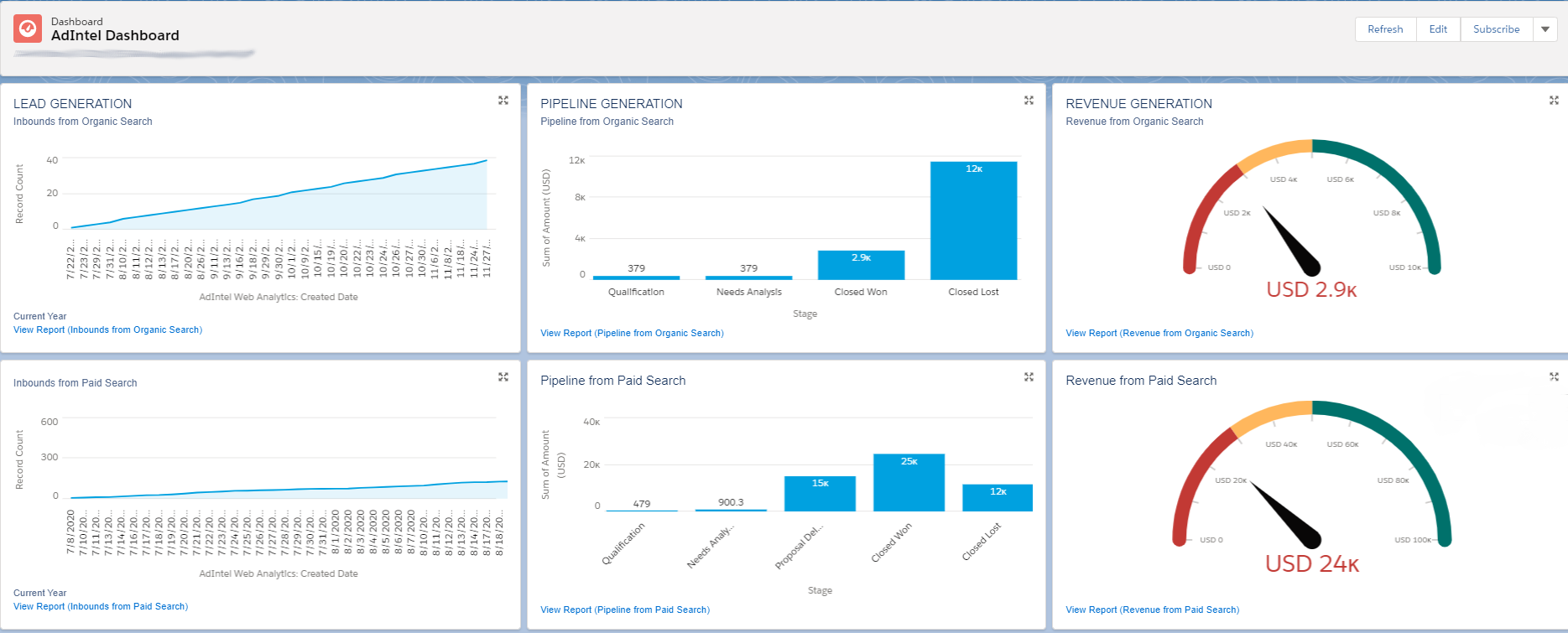

Marketing teams invest significant time and budget into generating leads through Google Ads, Microsoft Ads, Meta Ads, organic search, email campaigns, and other digital channels.
When a lead finally converts, most organizations celebrate the handoff to Sales and move on to the next campaign.
Unfortunately, an important Salesforce process is often overlooked at this stage:
Ensuring the converted contact is associated with the opportunity through an Opportunity Contact Role.
While this may seem like a small administrative detail, it can have a significant impact on marketing attribution, ROI reporting, and the accuracy of pipeline and revenue metrics.
For AdIntel customers, maintaining this relationship is especially important because it helps preserve the connection between marketing activities and the opportunities they ultimately influence.
The Journey Begins with Lead Capture
When a lead is created, the AdIntel App automatically captures valuable marketing intelligence about how that lead was acquired.
This information is stored in the AdIntel Web Analytics records and may include:
- Traffic source
- Marketing campaign
- Ad campaign
- Ad group
- Keyword
- Search query
- Organic search information
- Additional web analytics details
This intelligence provides critical visibility into which marketing initiatives are generating inbound leads.
Instead of merely knowing that a lead was created, marketing teams gain insight into exactly how that lead entered the system.
What Happens During Lead Conversion?
When a lead is converted in Salesforce, the lead typically becomes:
- An Account
- A Contact
- Optionally, an Opportunity
If the user chooses to create an Opportunity as part of the conversion process, Salesforce automatically adds the newly created Contact as an Opportunity Contact Role.
Everything works exactly as expected.
The relationship between:
- Marketing Source
- Contact
- Opportunity
remains intact.
This means AdIntel can continue connecting marketing activities to sales pipeline and future revenue.
The Hidden Problem
The issue typically arises when users convert a lead but choose not to create an opportunity during the conversion process.
This is a common business practice.
For example:
- The prospect may still be in qualification.
- Sales may want additional conversations before opening an opportunity.
- The organization may have strict opportunity creation criteria.
In these situations, Salesforce creates:
- Account
- Contact
but no Opportunity.
Days or weeks later, a sales representative manually creates an Opportunity for that Contact.
At this point, many users assume everything is properly connected.
Unfortunately, that is not always the case.
Why the Missing Contact Role Becomes a Problem
When an opportunity is created manually after lead conversion, Salesforce does not automatically add the Contact as an Opportunity Contact Role.
The opportunity may exist.
The contact may exist.
The account may exist.
However, the relationship between the contact and the opportunity may be missing.
This seemingly minor omission can create significant reporting gaps.
Why AdIntel Depends on This Relationship
The AdIntel App tracks marketing attribution data through the lead and then associates that information with the converted contact.
This design helps preserve valuable acquisition intelligence long after lead conversion.
For example, AdIntel may know that a customer originally came from:
- A Google Ads campaign
- A Microsoft Ads campaign
- A Facebook advertisement
- An organic search query
When the contact is properly associated with an opportunity through an Opportunity Contact Role, AdIntel can trace the relationship between:
Campaign → Lead → Contact → Opportunity
This chain is essential for accurate marketing attribution.
How ROI Calculations Depend on Opportunity Data
Marketing leaders are increasingly expected to prove the value of their investments.
Questions they commonly ask include:
- Which campaigns generated pipeline?
- Which keywords influenced opportunities?
- Which advertising channels created revenue?
- What was the return on marketing investment?
To answer these questions accurately, marketing attribution must connect marketing activities to opportunity values.
For example:
A Google Ads campaign generates a lead.
The lead becomes a contact.
The contact later influences an opportunity worth $250,000.
If the Contact Role relationship exists, AdIntel can correctly associate that opportunity value with the advertising campaign.
If the Contact Role relationship is missing, the opportunity may not be attributed correctly.
As a result:
- Pipeline attribution becomes incomplete.
- Revenue attribution becomes less accurate.
- ROI calculations may be understated.
- Campaign performance reporting may become misleading.
A Real-World Example
Imagine your company invests $50,000 in digital advertising.
One campaign generates a highly qualified lead.
The lead converts into a contact.
A few weeks later, a salesperson creates a new opportunity worth $500,000.
However, the salesperson forgets to add the contact as an Opportunity Contact Role.
From a sales perspective, this might not appear to be a major issue.
The opportunity still exists.
The deal can still progress.
Revenue can still be booked.
But from a marketing attribution perspective, the connection between the original campaign and the opportunity may be weakened or lost.
When management later reviews marketing ROI reports, that $500,000 deal may not be fully reflected in campaign attribution.
Suddenly, a high-performing campaign appears less successful than it actually was.
This can lead to poor budget and investment decisions.
The Impact on Executive Reporting
Many organizations use AdIntel dashboards and reports to answer questions such as:
- Which campaigns generated the most pipeline?
- Which advertising channels generated the most revenue?
- Which keywords create the highest-value opportunities?
- What is our overall ROI?
The accuracy of these reports depends on maintaining proper Salesforce relationships.
Missing Opportunity Contact Roles can result in:
- Underreported pipeline
- Underreported revenue
- Incomplete attribution
- Reduced confidence in reporting
Marketing managers may end up defending reports that are missing critical information simply because a relationship was never established in Salesforce.
Best Practice: Always Add the Contact Role
Whether an opportunity is created during lead conversion or created manually later, organizations should establish a consistent process:
Whenever an opportunity is associated with a known contact, that contact should be added as an Opportunity Contact Role.
This best practice helps ensure:
- Accurate marketing attribution
- Reliable pipeline reporting
- Correct revenue attribution
- More accurate ROI calculations
- Better executive visibility
It also helps Sales and Marketing maintain a shared understanding of how opportunities originated.
Supporting Better Marketing Decisions
Every marketing team wants to know which investments produce results.
When attribution data is incomplete, organizations risk making decisions based on partial information.
Campaigns that appear to underperform may actually be generating substantial revenue.
Advertising channels that appear ineffective may actually be driving large opportunities.
Complete Opportunity Contact Role data helps ensure that AdIntel can accurately connect the dots between marketing activities and business outcomes.
A Small Step with a Big Impact
Adding a Contact Role to an Opportunity takes only a few seconds.
Yet the impact on reporting quality can be substantial.
By preserving the relationship between contacts and opportunities, organizations enable AdIntel to deliver more accurate:
- Pipeline attribution
- Revenue attribution
- Campaign performance metrics
- Marketing ROI calculations
In today’s data-driven marketing environment, these insights are critical for making informed investment decisions.
The Bottom Line
Lead conversion is not the end of the customer journey.
For accurate marketing attribution, it is essential to maintain the relationship between the converted contact and any opportunities that arise from that contact.
When opportunities are created manually after lead conversion, adding the contact as an Opportunity Contact Role helps preserve the connection between marketing campaigns and revenue generation.
For AdIntel customers, this relationship plays a key role in ensuring that pipeline, revenue, and ROI calculations accurately reflect the true impact of marketing efforts.
A simple Contact Role assignment today can make the difference between incomplete attribution and a complete picture of marketing performance tomorrow.
Ready to Get More Accurate Marketing Attribution?
AdIntel helps organizations connect campaigns, leads, contacts, opportunities, pipeline, and revenue into a complete marketing attribution framework within Salesforce.
Start using the App right away by following the steps described in the installation and setup guide.